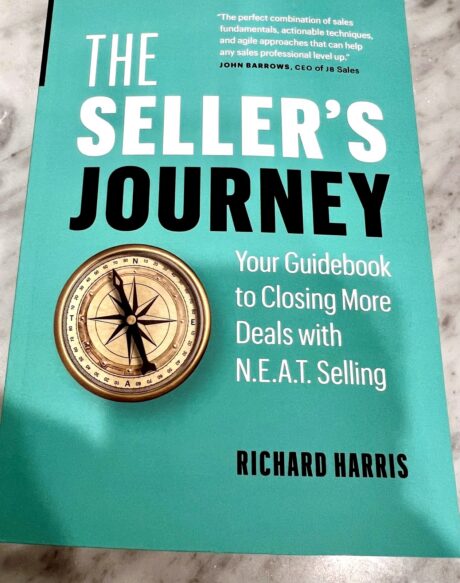


Your sales qualification training resource: perfect discovery and qualification signals, questions and coaching approach so you stop chasing ‘maybes’.
Updated for 2025-2026 | By Richard Harris, The Harris Consulting Group
What You Will Learn
- Why closing skills are not the problem.
- Qualification and Discovery are NOT the same thing. And you need both.
- How N.E.A.T. Selling™ addresses standard flaws in legacy frameworks.
- Examples of discovery and qualification questions that prevent bloated pipelines.
- How to train your team on qualification and make it stick.
- Why disqualification is sometimes better than qualification.
- Q&A about sales qualification answered so you don’t have to search.
Your Closing Problem Is Really a Qualification and Discovery Problem
I always go against the grain. ‘The customer is always right’, actually, the customer is always wrong, if they were right, they wouldn’t be contacting me for training. Here’s an example of what I hear all the time, ‘Our team needs to close better.’
Almost everyone I speak with tells me they have a closing problem. As I dig in I help them realize it’s not the closing skills that are bad, its the fact that their discovery skills suck. And the more they keep focusing on closing and not better discovery, they are just accelerating the suck in the forecast. As I said everyone thinks they have a closing problem, and then I ask them to tell me why their deals aren’t closing. And it’s the standard answers:
- We didn’t have the right champion
- We didn’t know why the deal pushed
- We lost to a competitor
- We didn’t discount enough
I could go on and on, as I am sure you can too. As we can see, it’s not the closing that’s the issue, it’s the lack of proper qualification and discovery. The deal was never real in the first place.
The prospect wasn’t a prospect, they were a suspect at best and just kicking tires. There was no economic impact, there was no discussion about skeptics, there was no discussion about the approval process. The decision-maker was never in the room. Then the sales rep thinks they are ready to close, and poof, the suspect ghosted them.
We have to be careful about sales discovery and qualification. Sometimes sales qualification strategies overindex on making it about you, the company, and what you who you want as a customer. This matters, just be careful. The goal of sales qualification and discovery is to determine, as soon as possible, whether a suspect is a genuine prospect and if there is potential for a viable opportunity worth your time, and your revenue teams’ resources. When you do it right, the pipeline and revenue have healthy and more predictable growth. Do it wrong, then those deal review meetings with your executive team become very uncomfortable. And it is very evident that you have bloated pipelines, inaccurate forecasts, frustrated reps, and missed quarters.
This guide is for every sales leader who has watched a deal die at the finish line and wondered why nobody saw it coming. The answer is almost always in the quality of qualification at the start.
Author’s Note: Some people say qualification and discovery are the same thing. Some say they are different. Often times SDRs do qualification, and AEs do discovery. In this article we are going to treat them similarly. It’s up to you to determine what’s right for your organization.
What Is Sales Qualification And Discovery?
Sales qualification and discovery means having a specific process of determining and understanding whether a prospect is real. It does not just mean the person you are talking to, it also means the organization they represent. Are they really ready to commit to deeper conversations?
Remember, this entire process is multi-directional. They are qualifying you as much as you are qualifying them. You’re trying to discover if they can buy, not just if they will buy, and should we even sell to them? They are trying to figure out if they can trust you enough to put their internal reputation on the line, as well as whether or not you can fulfill their actual needs.
We’ve all closed deals to chase the revenue or the logo only to find out it’s a terrible partnership later. It creates a horrible experience for everyone. And it’s your brand and reputation on the line. Oh, and when I say your brand, I mean you the sales person and sales leader, not just the company. We all know a deal that closes but produces a terrible customer experience, excessive support burden, ridiculous demands or rapid churn is not worth a moment of anyone’s time. A solid sales qualification and discovery process starts to help filter this out sooner than later.
Remember: Sales Qualification and Discovery is ongoing, it’s not just an exercise at the top of the funnel. There’s a big difference between qualifying a deal initially, and then qualifying it as a commitment to your forecast. Best practice for sales teams is to qualify and discover early and often. For more on building forecast accuracy from qualification discipline, see our guide on sales forecasting best practices.
The History and Failure of BANT
Ah… the dreaded BANT – Budget, Authority, Need, Timeline, is one of the earliest qualification and discovery sales methodology frameworks that simply will not just die already. Allegedly IBM developed it, and while I did sell in the 1900s (late 1900s), I don’t know if it ever truly worked. It was a good starting point and I suppose we should respect it, but it’s not built for the modern sales team or sales world.
Here’s what is frustrating about BANT. It’s selfish. It focuses entirely around the seller’s needs and does nothing to understand the buyer’s reality. You end up interrogating your prospects and customers to get four pieces of information. And in most cases you haven’t earned the right to ask those questions. And let’s face it, do we really think an executive is going to sit there and just answer these questions right away?
Where BANT Fails in Modern B2B Sales Qualification
These days a budget may not even exist for what you offer. And even if it does, they aren’t giving up that number anytime soon. The budget conversation does not belong at the beginning of a sales process. And, the budget is only allocated once a compelling business case exists along with the solution. It’s not simply based on the pain itself.
Most of us learned there are four topics we don’t discuss comfortably. Politics, Sex, Religion, and Money. Asking about the budget before you’ve shown them you understand their problems and discussed the real economic impact of their situation is premature, if not downright rude.
It’s no longer about Authority. It’s specifically about Access to Authority. There are so many committees for an organization to make a decision you won’t ever get to authority anytime soon. There’s the vendor trial committee, the approval committee, the budget committee, the legal committee, and a host of others. Even when there is the ‘final approval’, that person also takes in the comments and advice from all the committees. If you’re only looking for the one decision maker, you’re doing it all wrong.
Need, based on the BANT approach feels fake, it’s surface level pains, it’s not core pains. Just because someone needs a solution for phishing is not enough for a company to actually sell them. If that’s all you got, then you’re simply checking ‘need’ off a list. It creates false confidence. Real discovery questions dig deeper and get to the root causes and core pains that establish a true economic impact to their needs.
Timeline, as typically asked in BANT just gives reps happy ears. Meaning it’s a date and the rep believes it, they never re-qualify it from six different angles. Yet reps want to believe them and never go deeper. The more powerful question is what’s driving the urgency, or what happens if you don’t launch by a certain date?
For a full side-by-side breakdown of how NEAT compares to BANT, MEDDIC, SPIN, and Challenger, see our deep-dive: Which Sales Framework Does Your Team Actually Need?
N.E.A.T. Selling™: A Modern Sales Qualification and Discovery Framework
I built the NEAT Selling™ sales methodology because a more modern approach was needed. And it should be noted, you don’t have to follow the order of the letters in N.E.A.T. Selling. It’s specifically meant to be fluid. All sales conversations are fluid, like jazz music, there’s a lot of improvisation, but it’s structured enough to be a process.
NEAT is less complex than MEDDIC, more realistic than SPIN Selling, and more realistic than Challenger Sales. NEAT stands for Need, Economic Impact, Access to Authority, and Timeline, and the framework approaches each of these differently than BANT or frankly many other frameworks. Although, perhaps I am slightly jaded because it’s my baby. And my baby is stunning!
N, Need: Go Three Layers Deep
NEAT forces you to dig in deep, to ask very specific questions that help your prospect understand the real pains they have, and how it actually affects them.
A prospect saying ‘we need sales training’ is a category, not a specific need. The NEAT approach pushes for specificity in their unique world. Sure everyone I talk to says something like ‘we need sales training’, however, every organization has something unique about their specific needs, so we go deeper. When you say you need sales training do you mean:
- Do you mean prospecting training at the top of the funnel or sales training?
- When you say prospecting training do you mean cold calls, emails, LinkedIn?
- What’s your use case as you think about your sales reps who need sales training?
When a rep can get the prospect to share deeper answers like these, you get closer to the core problem. And you actually build real trust because the prospect feels seen, heard, and understood. Now you know you have qualified for Need. Anything else is just an illusion caused by smoking hope-i-um. And this is one reason the deal dies.
E, Economic Impact: No Number, No Reality, No Deal
This is the component that most differentiates NEAT Selling from legacy frameworks. If you talk about budget before you’ve discussed their specific Economic Impact, you’re already failing. And you’re probably giving up all the control.
We have to ask the kinds of questions that encourage the prospect to give real numbers based on their specific use case(s). If a prospect cannot give you numbers, then there is really no deal to be had. You cannot build a business case for your solution without knowing the value of their problem. Your value is meaningless without it. Budget decisions are made based on Economic Impact. If there’s no ROI narrative, the deal will stall.
Your job in qualification and discovery is to help the prospect build that number together. And you do this by asking:
- What’s your average deal size?
- What’s your average sales cycle?
- How many reps are struggling?
- How much did you miss the number or are you behind this quarter?
Then, when it’s time to build the use case you use their numbers. From there your pricing is nothing in comparison to their pain. And they cannot argue their numbers are wrong. This will help you later in negotiations.
A, Access to Authority: Map the Buying Committees
It’s about Access to Authority not getting to a decision maker. You’re never getting to upper management until you understand all the committees and committee members. You also have to win the trust of your prospect so that they will feel comfortable introducing you to these people. They are the ones who are risking the most to bring you forward. And, in many cases sales reps believe they have a champion, when at best they might have a cheerleader.
You figure this out by asking the following questions:
- When you take this back to your team, who on the team is generally the most skeptical?
- What would they be the most skeptical about in relation to this project and selecting a vendor?
- If you love us, and they are luke-warm, or even hate us, what happens?
- Would it be helpful for me to provide ____ and ____ now so you don’t become a ping-pong ball?
When you ask these questions as I’ve written them, the entire world opens up. You get so much clarity on where the deal really sits it’s amazing.
T, Timeline: What Is Driving Urgency?
The NEAT sales methodology addresses the timeline completely differently than BANT, which makes it a seller centric question. It’s not about when you want to close, it’s about them feeling enough pain that they need to buy right now. You can actually work to create urgency when addressing the timeline. Whether they want to move that quickly is the next layer of timeline. You get there by asking these types of questions:
- What’s happening now that makes this so important as opposed to six months ago?
- What is the detrimental fallout if the project doesn’t launch by ____?
- Who will be held responsible if the project doesn’t launch?
- What other teams are affected by this decision and timeline?
- How does the economic impact discussed adjust urgency of this project over others?
The 8 Most Important Sales Qualification and Discovery Questions
1. ‘What made you want to take this call today?’
This is the best first question to ask after running a Respect Contract. It gives them space to tell their story, and get them talking which forces you to begin active listening. Whatever their answer is, it can be immediately followed up with something like, ‘I hear about your concerns about cyber security and phishing a lot. It’s often a similar problem, but it’s also unique at every company I speak with. Can you tell me a bit more about your specific concerns?’ All of this triggers personal, deeper, and emotional conversations. Purchasing decisions are driven by emotions. That’s why getting to core pains is so important.
2. ‘How are those pains actually affecting the organization?’
This is the beginning of an economic impact question. In reality, Economic Impact questions are one of the main drivers towards urgency for the buyer. The more they share the numbers around their pains, the more dire and urgent the pain begins to feel in their mind. And it sets a natural transition to discuss commercial terms.
3. ‘Who’s budget will this be coming from?’
Asking the budget question this way opens the door for the conversation. It also opens the door to understand more about access to authority. Making it an open-ended question is the jazz part of the conversation. It allows you to take the conversation in a couple of different directions.
4. ‘Who else is affected by this decision?’
Non-threatening and direct. You are not suggesting they cannot make the decision, you are simply showing them you understand while it’s their decision it can affect others, which is about their internal political capital. It will also help you determine who some of the skeptics might be and what they would be skeptical about.
5. ‘How does your company like to evaluate solutions?’
Again, non-threatening. Because you keep it at the company level it does not put them on the defensive. Additionally you will get greater insights into timeline, access to authority, and even economic impact and need. Best of all it tees you up to now ask about the competitors they are evaluating alongside you.
6. ‘What’s the good that happens after a solution is implemented?’
This is the reverse psychology of pain. You’re now talking about relief. Which again is an emotional trigger. When they can paint a picture of relief it helps them feel good about you as a partner. It can also be an indication of whether or not they are truly serious about solving the issue. It also helps define the success criteria for which you will be evaluated as a whole and against any competitors, including the ‘sticking with the status quo’ competitor.
7. ‘What hangovers exist from previous purchasing decisions in your organization?’
Everyone knows what a hangover is, and every organization has them. Even if it’s not directly linked to your competitor, simply understanding the potential pot-holes and pitfalls is massively helpful when qualifying. This will often be something your point of contact doesn’t realize because maybe it affected their boss(es) more than it did them directly in other purchases. It also shows you care about them and don’t want to make them look bad. Which then means you are closer to getting short-listed.
8. ‘What other projects could prevent this from moving forward?’
Sometimes you lose to an internal competing project and you didn’t even know it. Similar to the ‘skeptic questions’ this helps you understand where the importance of this decision really is in the organization. It can open doors to Need, Economic Impact, Access to Authority, and Time. The sooner you know this, the easier it is to either overcome and decide how to accurately pipeline the deal.
What Great Sales Disqualification Looks Like
Let’s flip the script a little. Let’s talk about disqualification. Remember disqualifying someone prevents you from wasting time and energy on chasing maybes. These are as much signals as they are ideas for asking questions differently.
Here are the signals that it’s time to disqualify:
- The prospect cannot quantify the economic impact of their problem after two calls
- There is no clear path to the actual decision-maker after multiple attempts
- The timeline is entirely vague and there are no external drivers creating urgency
- The prospect has been evaluating solutions for more than 6 months with no decision
- The use case doesn’t actually fit your product’s core capability
- The budget conversation is consistently deflected or avoided
- The prospect has zero awareness of any internal stakeholders who’d need to approve
- You’ve been talking exclusively to one person in a deal that clearly requires multiple approvals
The Disqualification Conversation Set-Up: Be sincere and direct. Even lower your voice and slow down your pace. Ask something like, ‘I feel like there may be some mixed signals here and I don’t want to waste your time. Based on our discussion do you feel we are in the right place to move this forward or should we press pause until we know more about ____?’
How to Build and Enforce a Sales Qualification Standard
If your qualification and or discovery framework is something someone saw in a deck during onboarding, that’s a problem. And it often leads to the ‘reps are doing it their own way and we need a common language’ pain I hear about all the time. The best sales frameworks are actually built into the CRM. It reminds the reps to actually ask the questions that need to be asked.
Step 1: Define the Exit Criteria for Each Stage
What specific pieces of information are necessary to move from one stage to the next. From Qualifying to Discovery, from Discovery to Selection, from Selection to Negotiation, and Negotiation to Closing. And remember, Demo and Proposal sent are not stages, those are the exit criteria.
Step 2: Build It Into Your CRM
There’s a balance between gathering information and field creep. Yes, this needs to be built into the CRM, however a rep should not have to fill out a bunch of fields on the opportunity layout. Additionally, if you aren’t using technology to fill in 90% of these fields, again, you are part of the problem.
Step 3: Inspect It in Deal Reviews
Stop asking stupid questions in deal and pipeline review meetings. Stop asking for information that is in the CRM but you are too lazy to look up.
The single best question a sales leader should ask about any deal is simple: ‘What’s the one thing preventing this deal from closing by the end of the quarter?’
There is always more than one thing, however the human brain cannot remember it all. Forcing them to focus on one thing will actually help them remember all the things that are preventing the deal from moving forward.
After they answer this question and you strategize, you are allowed to ask about the other things that we know can affect the deal but were not brought up. ‘What’s the specific business problem?’ ‘Who are the stakeholders we’ve talked to?’ ‘What’s driving urgency?’ If a rep can’t answer those from memory, the deal is not qualified, and the review has just identified a coaching opportunity.
Step 4: Celebrate Great Disqualification
This seems counter-intuitive, I know. I once had a boss spiff us on any deal we disqualified. And we had to disqualify it by asking very specific questions. This made it fun, triggered some muscle memory, and helped us stop chasing maybe. It also allows for some quick wins in the middle of a month or quarter rather than waiting until the end.
Sales Qualification, Discovery and Forecasting for Real Revenue
Your forecast will never be perfect. And frankly you shouldn’t expect it to be. You can expect your forecasting to get better month over month, quarter over quarter. Remember, your forecast is only as accurate as your qualification and discovery is disciplined. For the full playbook on building a forecast your executive team will actually believe, see our guide to sales forecasting best practices.
Friction and fiction affecting your forecast. When reps are chasing maybe it’s adding a lot of friction to their sales motion. They are spending time on the wrong deals which means there is less time and more friction getting to the right deals. Additionally, without a strong sales discovery process, your pipeline has more fiction. It feels like a movie that’s ‘Based on a True Story’, but in reality there wasn’t much truth in it at all. Deals have expiration dates just like milk. These are the signals: not knowing who the skeptics are, not knowing other competing priorities in the organization, always asking for discounts, not knowing who you’re competing against. And you will see it week after week and quarter after quarter.
The only solution we know of is having a strong sales qualification process. One that provides a solid structure without making your sales reps sound robotic. The antidote is qualification and discovery rigor at the front end. If you don’t have clear definitions for every deal around Need, Economic Impact, Access to Authority, and Timeline, all you really have is a pipe-dream, not a pipeline.
Sales Qualification Training: How to Build the Skill Across Your Team
Qualification is a sales skill, not something covered in onboarding. It requires consistent training, role playing, feedback, and reinforcement. Here’s what that looks like in practice:
Train the Framework Explicitly
Sure a rep you hire may have done qualification and discovery at other sales jobs, but they haven’t done it at your organization. You have to teach them what good qualification and discovery means at your company. Train and coach it as a specific skill. Role-play and call reviews. Let me say that again, role-play and call reviews. Our 4-Week N.E.A.T. Selling Training and Reinforcement Program is built specifically to make this kind of training stick, not just land.
Role-Play the Hard Questions
If your team is uncomfortable asking questions, that’s actually a good sign. It’s a signal that you, the sales leader, need to spend time training and coaching them on these specific use case scenarios. Most of the time a rep is afraid to ask these questions simply because they haven’t asked them before. Part of what we train is earning the right to ask questions so reps feel confident, not scripted, when the hard conversations come up.
1:1s Are Not Just About Pipeline
Sales leaders, if every 1:1 is about the pipeline then you are not really doing 1:1s, you’re simply trying to CYA for your next meeting with upper management. You should have no more than 5 1:1s each quarter be about pipeline. Yes, you can still have other conversations, just don’t do them in 1:1s.
Post Mortem Lost Deals With Qualification in Mind
Everyone wants to know why a deal did not close. The value of a strong sales qualification process means you know which questions to ask when you do the post mortem. Otherwise, you’re all just sitting around making up stuff to try and prevent getting in trouble. When you have a good discovery system and post-mortem exercise it surfaces the areas where more training, coaching and reinforcement is necessary.
Frequently Asked Questions About Sales Qualification and Discovery
What is the best sales qualification and discovery framework?
If you’re looking for sales qualification training that actually sticks, N.E.A.T. Selling™ is our framework of choice. It was created because all the other systems felt outdated, overweighted, and unrealistic. BANT is outdated. MEDDIC is excellent for very large enterprise and complex sales but can be over-engineered. NEAT offers the right balance of rigor and practicality for most B2B sales teams. You can explore the full N.E.A.T. Selling methodology here, or take the online training course to start applying it immediately.
Should I rip and replace my sales qualification and discovery system?
This may surprise you, but the answer is no. I am not a fan of rip and replace. Most of the time the issue isn’t the qualification or discovery program, it’s the lack of training and coaching around what is already in the system. So ripping and replacing won’t be any better if there is not consistent training, coaching and reinforcement.
When should qualification and discovery happen?
Everywhere. All the time. In every conversation. It’s that simple. The challenge is knowing your sales cycle and its various stages and making sure you have the proper exit criteria to help you define if the deal is qualified to move to the next stage. Re-qualification is how you prevent deals from rotting in your pipeline and simply creating a pipe-dream. Deep dive discovery helps you avoid pitfalls and pot holes.
How do you qualify inbound leads differently from outbound?
You actually don’t. You may spend less time on certain topics, but don’t skip a step. In some ways you are evaluating them as part of the qualification and discovery process. They still have to answer the same questions outbound opportunities need to answer. After all, the only difference is how you got to the first touch.
What percentage of prospects should get disqualified?
There’s no real universal answer to this. Over time you could probably use some level of AI to help you determine what should be disqualified or should have been disqualified. Additionally you can look at certain metrics and ratios:
- How many first meetings turned into second meetings
- How many second meetings turned into third meetings
- How many demos moved forward to closed won / closed lost
- How many deals did you beat a competitor / lose to a competitor
- How long is each deal staying in each stage of your sales cycle?
How do you qualify without sounding like you’re interrogating the prospect?
Pace, Tone, and Open-Ended Questions. Focusing on these three things matter the most. The best place to start is by listing the exit criteria you need from stage to stage, then determine the open ended questions needed, and then practicing a curiosity tone. This tone often sounds like you’re lost and asking for directions. The natural human instinct of altruism kicks in and your prospect actually wants to point you in the right direction.
What is the difference between qualification and discovery criteria and exit criteria?
Qualification and discovery criteria define whether a deal belongs in your pipeline at all. Exit criteria are specific actions or specific pieces of information that need to happen or been discussed. This information is what is used to determine if the deal can move forward in your sales process.
How does qualification and discovery play in preventing late-stage deal stalls?
Any time we lose a deal it means something was missed. Sometimes that happens because we forget to ask, or don’t think it’s important, or simply never thought that would be an issue. Using the questions I’ve laid out above for each part of the N.E.A.T. Sales Methodology are designed to help reduce the risk of deals stalling at the end.
The Bottom Line on Sales Qualification and Discovery
Two people need to hear this part the most.
- Sales Leadership
- If you don’t move with specific intent to help your sales team improve their sales skills, why should they ever be committed to working for you or your company?
- Your organization cannot claim a people first culture if you are unwilling to support those who work for you.
- And when they leave you for a different job, you have no right to actually hold grudge against them, period.
- Sales Reps
- If you are waiting for someone to teach you how to make a peanut-butter and jelly sandwich, you’re doing it wrong.
- It’s 2026, you can easily get better at sales qualification and discovery on your own, and it doesn’t always have to cost money. Money is no excuse.
If you don’t learn how to get better at sales qualification and discovery all you are doing is increasing the friction and fiction of your pipeline and forecast. There is no ‘truthiness’ at all. You’re back to smoking hope-i-um as time winds down to the end of the month, quarter, or year.
This is not rocket surgery or brain science. Sales qualification and discovery skills are the easiest thing to improve that will actually flush junk out of the pipeline, improve forecasting, and increase close rates. It takes intentional effort by sales people and sales leaders to make this happen. So start closing deals and stop chasing maybe.
We’ve helped some of the biggest companies you’ve heard of and some of the many start-ups that are now reaching unicorn status. And we can help you and your team learn how to earn the right to ask questions, which questions to ask and when to ask them. Clients include: Zoom, Salesforce, GE, Visa, PagerDuty, Salesloft.
Happy to prove it to you with a free phone conversation. Let’s chat with you and help you and your team close more deals.
Related Resources From The Harris Consulting Group
- N.E.A.T. Selling™ Methodology — The complete qualification and discovery framework built for modern B2B sales.
- 4-Week N.E.A.T. Selling Training and Reinforcement Program — Live training with built-in reinforcement so the skills actually stick.
- N.E.A.T. Selling Online Sales Training — Self-paced access for individuals and teams. Available up to 12 months.
- Which Sales Framework Is Right for Your Team? — Full comparison of NEAT vs. MEDDIC vs. BANT vs. SPIN vs. Challenger.
- The Respect Contract — How to earn the right to ask the hard questions before you ask them.
- Earn the Right to Ask Questions With N.E.A.T. Selling — The trust-building foundation that makes qualification conversations feel natural.
- Sales Forecasting Best Practices — How qualification discipline directly improves forecast accuracy.
- Sales Training Services — Customized programs for SDRs, AEs, Inside Sales, Field Sales, and Customer Success.
- 1:1 Sales Coaching Services — Individual coaching for reps, managers, leaders, and founders.
- Contact Us — Every call is free. Let’s figure out if we’re the right fit for your team.
Richard Harris is the founder of The Harris Consulting Group and creator of the NEAT Selling™ methodology. A multiple Salesforce Sales Leader Award winner and AAiSP Top Sales Leader, Richard has trained thousands of sales professionals across global organizations.