
Updated for 2026
So you got approval for a sales training budget, and now it’s up to you to choose the best sales trainer. This is the scary part. If you choose the wrong sales trainer or sales training program, that’s going to hurt your internal brand at your company and could possibly cost you your job. And let’s face it, most of us have at least one “hangover” story from engaging with the wrong sales trainer at some point in our careers.
Choosing a sales trainer comes down to five things: their ability to help you define where you need the most help beyond “discovery, negotiation, and closing,” customization, a modern methodology, reinforcement sessions for both managers and reps, and referrals. The most popular trainer is not automatically the right trainer for your team.
Other things that matter are their ability to understand your sales motion, your current sales process, and your buyers. Industry experience is often considered a strong proof point, but that is not always the case. Teaching a sales rep how to earn the right to ask questions, which questions to ask, and when to ask them will always trump industry experience.
Quick Checklist: How to Choose the Best Sales Trainer
- Can they help you define your true challenges?
- Can they offer customized sales training and a reinforcement program?
- Do they use a modern methodology aligned with how your buyers buy?
- Is there a clear plan for practice and reinforcement?
- Will managers participate before, during, and after training?
- Can they provide independent reviews, relevant references, or documented results?
- Will the person you evaluate conduct the training and follow-up sessions?
- Is there a practical way to measure behavior change and business impact?
For a deeper comparison framework, read our Ultimate Guide to Choosing the Best Sales Training Companies.
One Responsible Trainer From Planning Through Reinforcement
The best sales trainers will be with you every step of the way. It’s important to confirm who will actually conduct the planning, training, coaching, and reinforcement sessions. With some providers, the person who sells the program is not the person who delivers it. You should know who will work with your team, what that person has personally sold or coached, and whether the same person will remain involved after the workshops.
At The Harris Consulting Group, Richard Harris handles every single step, from your initial conversation and planning through live training and reinforcement sessions. Everything runs through Richard. You will never be assigned a junior operator at any time during the process.
The Qualities the Best Sales Trainers Share
The top sales trainers share five qualities that separate them from average trainers.
1. Real Sales Experience, Not Just Theory
The best sales trainers have carried a quota, managed a pipeline, and coached teams. They know the grind of prospecting, the stress of quarter-end, and the pressure of executive reviews. Richard Harris has also shared his sales expertise as a contributor to Salesforce. Without firsthand experience, training becomes theory instead of practice.
2. A Proven, Modern Sales Methodology
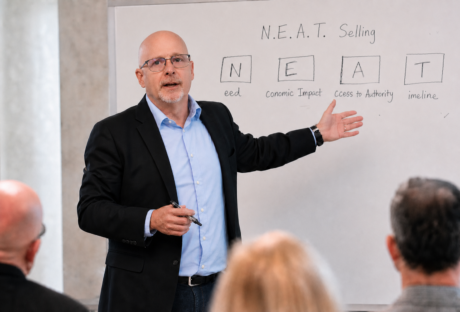
The best trainers don’t recycle outdated scripts. They bring frameworks built for today’s complex buyers. I teach N.E.A.T. Selling™ , built around Need, Economic Impact, Access to Authority, and Timeline , so reps sell consultatively instead of just pitching features.
👉 Related: Effective Sales Training
3. Training Customized to Your Buyers and Sales Motion
A SaaS company selling to mid-market prospects has different challenges than a manufacturing firm with long enterprise cycles. The best sales trainers in the world don’t show up with the same slides for every client. They customize sales training and adapt to your industry, sales motion, and team maturity.
If you are evaluating a partner for your team, see how our customized B2B sales training is built around your buyers, sales motion, and real opportunities.
4. A Practical Plan for Changing Sales Behavior
Motivational one-liners don’t close deals. True behavior change happens when reps practice discovery, objection handling, and negotiation until it becomes a habit. The best trainers measure success in outcomes, not applause.
5. Reinforcement for Sales Reps and Managers
One-off training days fade quickly. The best sales trainers build reinforcement plans that include ongoing coaching, role-playing, and manager enablement so skills don’t disappear after 30 days.
👉 See: Why Reinforcement is so Important to Sales Training
What Proof Should You Request From a Sales Trainer?
While a recommendation to a sales trainer from a peer is helpful, that does not mean you should assume they are the right sales trainer for you. Ask for evidence that is relevant to the work you need done. That may include independent reviews, client references, awards, case studies, examples of customized materials, or documented outcomes. You should also confirm that the trainer has personally sold, coached, or led in environments similar to yours.
A strong trainer should be willing to explain what changed for previous clients, what was measured, and what depended on the client’s managers and internal execution. If the sales trainer you are speaking with is not comfortable stating that results should be at least 10 times the cost, they are probably not the right sales trainer for you.
Which Type of Sales Training Partner Fits Your Team?
Aside from customizing the content, it’s important to consider a few other things. An independent or boutique trainer is often a strong fit when you want direct access, customization, continuity, and one person who stays close to the work. A large sales training company may be a better fit when you need simultaneous delivery across many regions or languages. A keynote speaker can create energy and awareness, but usually does not provide enough practice or reinforcement to change behavior. An online program can offer flexibility, but it often lacks customization. You should confirm whether coaching, practice, and feedback are included.
The right choice depends on the scale of the engagement, the level of customization required, and how much direct access you want to the person responsible for the work. The trainer and the program should be evaluated separately, so use this guide when choosing the right sales training program. Then learn how our customized B2B sales training is built around your buyers, sales motion, and real opportunities.
Want to know whether Richard is the right trainer for your team? Start with a conversation about your buyers, sales motion, managers, and the behaviors you want to improve. Talk with Richard about your team.
How to Spot a Bad Sales Trainer
It’s just as important to know the warning signs of a bad sales trainer as it is to recognize a good one.
❌ They can’t tie training to metrics (conversion rates, win rates, or sales cycle improvements).
❌ They rely on hype, not tactics (“rah-rah” but nothing reps can use on Monday).
❌ They’re still pushing outdated frameworks like BANT as the core model.
❌ They ignore frontline managers (leaving reinforcement to chance).
❌ They deliver the same canned program to every client.
👉 Related post: SaaS Sales Training Crisis: Why Your Team Needs More Than Just Scripts.
Why Reinforcement Sets the Best Sales Trainers Apart
The best sales trainers in the world know one thing most companies miss: training without reinforcement is wasted money.
Think about your last company offsite. Everyone left pumped up. But two weeks later? Old habits were back. That’s because without reinforcement, behavior change rarely sticks.
Reinforcement for Sales Reps
- Weekly role-play sessions to practice objections and discovery
- Call reviews with targeted coaching feedback
- Commitment loops where reps share what new skill they tried
Reinforcement for Sales Managers
- Coaching templates so managers know how to guide reps in 1:1s
- Deal inspection frameworks for pipeline reviews
- Leadership workshops to align managers with training goals
👉 For structure: 4 Week Sales Training and Reinforcement
When both reps and managers are reinforced, you build a culture of continuous improvement instead of relying on annual “training events.”
How Should a Sales Trainer Reinforce New Skills?
Live training should include role-playing and real-playing using your actual pipeline and ideal customer profiles. Each skill or tactic should be taught for a few minutes at most, then used by the team in actual role-playing and real-playing exercises.
After the live training, there should be weeks of reinforcement for the sales team as well as the managers. Managers are responsible for reinforcement and for making sure new hires are aligned. Ask how often reinforcement happens, what managers will receive, and how the trainer will adjust when the team struggles to use a skill. Our sales management training and coaching helps managers create that consistency.
Sales training is not a checkbox. The goal is not to complete a workshop. It is to help the team use better behaviors consistently in prospecting, discovery, qualification, negotiation, and closing conversations.
Step-by-Step: How to Choose the Best Sales Trainer
Here’s a simple framework to follow when evaluating trainers:
- Identify your top 2–3 sales challenges. (Prospecting? Negotiation? Discovery?)
- Look for industry-relevant experience. Ask if they’ve trained companies like yours.
- Ask about reinforcement. If they don’t have a clear plan, keep looking.
- Check leadership alignment. The best trainers involve VPs of Sales, CROs, and managers.
- Demand proof. Ask for client case studies tied to metrics.
👉 Learn more: Sales Coaching and Consulting.
FAQ: Choosing the Best Sales Trainer
Who is the best sales trainer in the world?
Of course we have a bias here, but that’s not the point of the question. You don’t want the best sales trainer in the world. You want the best sales trainer in the world to help you based on the sales skills your team needs to improve. The best fit is the person who can customize training based on your ideal customer profile and sales motions, has a modern approach, aligns well with your sales team, and includes reinforcement for both managers and sales reps after the initial training.
How do I choose the best sales trainer for my team?
Do not choose the prom king or queen. Just because someone is popular does not mean they are right for your sales team. The easiest way to determine fit is during your discovery process. The right sales trainer will help you define the specific skills your sales team needs at the right moments in your sales motions. They will also be honest from the beginning that if they cannot help you, they will refer you to someone better suited. Look at their track record, confirm they use a modern approach rather than something like BANT, and look for customization, live practice, manager involvement, reinforcement, and credible proof. Most importantly, confirm that the trainer you evaluate will be the person working with your team.
What questions should I ask a sales trainer?
Confirm their experience level and ask how they differentiate themselves from the competition. Ask whether they think your program requires a complete “rip and replace.” If so, do not hire them. Ask how they ensure customization and what support managers and leaders receive after the initial sales training session.
How much does a sales trainer cost?
Pricing depends on the number of participants, level of customization, delivery format, travel, manager involvement, and amount of reinforcement. Compare the full engagement, not only the price of the live workshop. If a trainer does not have an answer for you by the end of the first conversation, be wary of hiring them.
For a complete breakdown by delivery format, team size, customization, and reinforcement, read our guide to how much sales training costs in 2026.
Should I hire an independent trainer or a large sales training company?
An independent or boutique trainer may provide more direct access, continuity, and customization. A larger company may be a better fit for simultaneous delivery across many regions, languages, or teams. The right choice depends on scale and the level of personal accountability you want. In many cases, bigger does not mean better.
How long should a sales training engagement last?
Most teams need more than a single workshop. The engagement should allow time for planning, live practice, manager preparation, reinforcement, and feedback on how the skills are being used in real conversations. Four to 12 weeks is the norm, with the first week typically including the initial training sessions.
Should sales managers participate?
Yes. Managers should understand the skills and language, observe practice, reinforce the behaviors, and coach the team after formal training sessions end. We also believe executive leaders and marketing should attend. The more people across the organization understand how salespeople talk to customers, the better the overall alignment and strategy.
How should I measure the ROI of a sales trainer?
As much as I hate the phrase ROI, it matters, and your CFO is right to ask about it. The simple answer is 10x or more. Anytime a company invests in anything, it is not unreasonable to expect at least a 10x return. Just covering the cost of training by closing one or two deals is the wrong mindset. Obviously, there is no guarantee or universal formula. Challenge the sales trainers you are speaking with and see whether they are confident discussing something like a 10x return or whether they become wishy-washy. If they get flustered, how can you expect them to train your sales team to answer the same question when it arises?
Start with the behaviors the training is intended to change. Then track relevant measures such as call quality, opportunity progression, conversion rates, forecasting accuracy, discounting, and manager observations. Not every result can be attributed to training alone, so agree on realistic measures before the work begins.
Who conducts the training at The Harris Consulting Group?
Richard Harris handles the discovery, planning, live training, and reinforcement sessions. He is the only person you will communicate with, from the first conversation through the final reinforcement session.
Can the sales training be customized for our sales process?
Yes. The work should reflect your buyers, sales motion, value propositions, roles, real opportunities, and manager expectations. The methodology should support your process, not force your team into generic language that does not fit. N.E.A.T. Selling™ provides a modern framework that can support your existing sales process.
Richard’s Perspective
Bright lights and the biggest name may not be the best sales trainer for you and your team. You want someone who will take the time to make sure the team feels seen, heard, and understood. They will want to understand your sales motion, challenge your assumptions, work with your real opportunities, and stay involved after the initial training.
The best sales trainers will tell you when something already works and does not need to be ripped out and replaced. The goal is not to make your team sound like the trainer. The goal is to help your sellers improve while still communicating in their own authentic voices.
Final Thoughts: Finding the Best Sales Trainer for Your Team
The best sales trainer for your team is not automatically the most famous person or the person with the loudest online presence. It is the trainer who understands your buyers, sales motion, managers, and real opportunities, then stays involved long enough to help better skills become consistent behavior.