

Updated August 3, 2026
Ok, it’s not your fault. You want to buy a sales training program but your experience in actually buying one is limited at best, if not actually non-existent. You’re either researching ChatGPT, Claude, Gemini, or whatever and you think what it spits out is going to help you.
Short Answer
The best sales training program is not necessarily the most popular methodology or the most popular sales trainer. The best one is the one that can customize the training specifically for your organization, ICP, and sales motion. And yes, the trainer’s connection with your sales team definitely matters. If you’re just going after the biggest name or choosing someone because of a referral, there’s a strong chance you’re going to choose the wrong one. Make sure the training includes live role-play and real-play with your prospects and pipeline deals. It should include management participation, and it should definitely include reinforcement sessions for reps and managers after the primary training is complete.
AI can help you research the options, but it cannot make the decision for you or turn you into an expert buyer.
So I decided to write a guide for you on how to choose the best sales training program. And specifically, now that AI is a part of the conversation, where and how that fits into your analysis and decision making.
The best sales training program is not the one with the fancy logo salad, longest curriculum, the biggest brand, or the most impressive slide deck. The best one is the one that speaks to your sales motion, your entire revenue team, your sales methodology, and very specifically it should speak to your sales team in a way they understand and are willing to implement.
If your sellers cannot walk out of training on day one knowing at least one thing that they can try on their very next call, then you are choosing the wrong sales training program.
If you do not have sales management and sales team reinforcement training included as part of the program, you are choosing the wrong one.
This guide explains how to evaluate sales training programs based on methodology, customization, practice, manager involvement, reinforcement, measurement, duration, and cost.
What You Will Learn
By the end of this guide, you will know:
- How to define your goals and needs before choosing a sales training program.
- Why choosing a sales training program does not require replacing your current methodology.
- Whether a program addresses the right skills and behaviors
- Whether the methodology reflects how buyers purchase today
- How much customization your team actually needs
- Why sellers should practice with real calls, deals, and objections
- How managers should participate in the training
- How long the program and reinforcement should last
- How results should be measured
- What customized sales training should cost
- Which warning signs indicate a weak program
Start With the Desired Goals and Skill Improvements
Do not start by shopping for the most famous sales training programs or sales methodologies. You aren’t ready for that conversation yet.
Start with the business problems you need to solve and then the behavioral challenges your team needs help with in relation to solving the problems. So, the first step in choosing a sales training program is to define your goals and outcomes. Yeah, we know, you want to increase revenue. Except that’s not deep enough. You need to get deeper and closer to your true goals.
Here is what we walk you through in a conversation to make sure there is alignment.
If you tell us, “Our goals for a sales training program are to increase revenue.”
We will take you deeper by asking things like,
- Do you mean, net new revenue?
- Do you mean net revenue retention?
- Do you mean upselling and cross-selling?
- Where do these items fall into your strategic goals?
- Improved team culture
- Greater team retention,
- Ability to recruit better salespeople?
Obviously revenue is the main driver, it’s simply important to know which types of revenue. And I think everyone wants a better culture, easier recruitment and better employee retention. We simply share this because we believe it all matters. And yes, revenue is the main driver, we get it.
If upselling and cross-selling are part of your goals, then the conversation isn’t just about a sales training program for the sales team, it’s about a program that can be utilized by the account management and customer success team as well.
Ok, so we defined some goals, but we aren’t done defining your specific needs. And here is where customization comes into play. We will ask you,
“At the end of an engagement, we expect the sales team to be better at ____, _____, and _____. “
You may answer with things like, “prospecting, discovery, negotiation, and closing”.
All very reasonable and absolutely critical.
The best sales training program will help you define this in a use case scenario specific to your business model. It goes something like this…
“When you say negotiation, what do you mean exactly? Do you mean negotiating with procurement, or just stop the discounting? Do you mean understanding the give and take of a discounting conversation if you have them?”
And no, we still aren’t done. You have to define your success criteria. By following this guideline.
“We will define success as an increase (or decrease) in ____, ____, and ____. And if we do not have baseline numbers yet, then we will commit ___ months to establish a baseline.“
Do not think that two weeks of data will be enough of a baseline.
The best sales training programs aren’t just about the program itself, it’s actually about confirming your evidence of the challenges you present. It’s about confirming your specific goals and positive outcomes first and then aligning them with the program itself to see if it feels like the right fit for you and your sales team. It’s critical you make sure the program specifically addresses those needs and how it will turn into a repeatable behavior.
Here is a list of challenges we hear over and over from clients. Your job is to define them in your specific day-to-day world of running a sales team.
Your team may be struggling with:
- Demonstrating value
- Qualifying opportunities honestly
- Controlling the conversation
- Running meaningful discovery calls
- Getting multi-threading
- Confirming next steps
- Better demo skills
- Needing a common language
- Objection Handling
- Stop discounting
- Improving courage, confidence and consistency.
- Connecting your solution to business impact
- Improving forecast accuracy
- Coaching sellers consistently
The best sales training programs will help you create a clear definition and understanding of your challenges. And they will help you prioritize your list so that execution will be both meaningful, useful, easy to understand, and most importantly, easy for your sales team to implement.
For example, if sellers are booking meetings but few opportunities progress, generic prospecting training is unlikely to solve the problem. The actual gap may be discovery, qualification, or the ability to build a business case. The training should follow the evidence.
Do You Need to Replace Your Current Sales Methodology?
Doing a rip and replace of your current sales methodology is not necessary in many cases. In fact, we rarely recommend it. Most of the time it’s not that the wrong methodology was being used, it was simply that it was not being coached appropriately. So replacing your current sales methodology isn’t going to work if there isn’t going to be significant improvement to sales training and coaching.
It is important to recognize your sales team may already have a defined sales process but need stronger discovery, qualification, messaging, negotiation, or manager coaching. In that situation, replacing the entire methodology would create disruption without solving the real problem.
Before selecting a program, ask:
- What parts of our current methodology do sellers use consistently?
- Where do sellers and managers struggle?
- Which behaviors need to improve?
- Can the new training work within our existing sales stages and tools?
- What terminology should remain consistent?
- What should be added, simplified, or removed?
A credible training provider should be able to explain how its program will integrate with your current system. Be cautious when a provider insists that everything must be replaced before fully understanding how your team already operates.
The goal is not to introduce change for the sake of change. The goal is to improve the behaviors that affect performance while preserving the processes, language, and tools that already work.
Modern Methodology Matters
The biggest challenge we see these days is that salespeople are disconnected from the humanity of conversation. This is not simply a generational thing, it’s happening everywhere to everyone. Modern buyers have more information, more choices, and less patience for scripted sales tactics. A strong sales training program should help sellers understand the buyer’s situation without turning the conversation into an interrogation.
The methodology should teach sellers how to:
- Earn the right to ask questions, know which questions to ask, and when to ask them.
- Teaching sellers how to uncover true economic impact, not a simple ROI calculation.
- Teach sellers how to surface detrimental fallout if things don’t change
- Qualify opportunities without pressuring the buyer
- Improve multi-threading
- Create urgency based on the buyer’s reality
- Discuss value before negotiating price
- How to handle objections
- How to properly deliver pricing and not succumb to discount requests.
- Make it safe for the buyer to say no
And to do all of these things in their authentic voice, not just sound like an AI Bot in sales. The goal is not to give sellers a rigid script. It is to create a common language and a repeatable way to think through conversations.
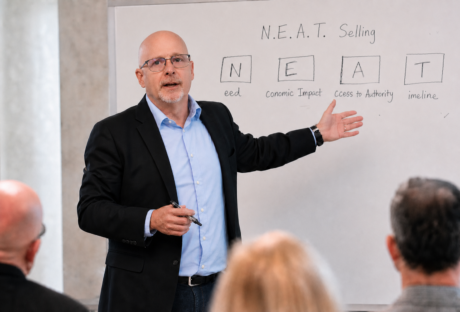
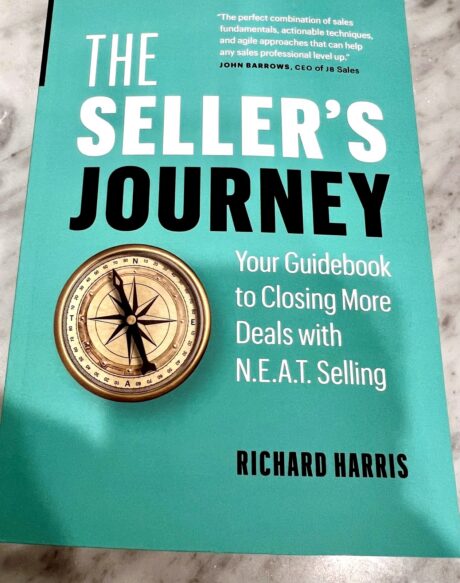
A methodology such as N.E.A.T. Selling™ can support this approach by helping sellers understand Need, Economic Impact, Access to Authority, and Timeline. It should work with your existing sales process instead of forcing your team to replace everything at once. There is never a need to rip and replace. In fact, we discourage ripping and replacing.
Customize the Program
Adding your company logo to a standard presentation is not customization.
Real customization begins before the training ever takes place. The training provider should learn how your team sells, who your buyers are, where deals stall, and what managers are already coaching. In short, the training provider has to do some homework.
Meaningful customization can include:
- Interviewing sales leaders, managers, and sellers
- Reviewing recorded sales calls
- Examining real opportunities and lost deals
- Understanding your ideal customer profile
- Adapting exercises to different sales roles
- Using your terminology, sales stages, and common objections
- Connecting the training to your current tools and process
- Creating examples around your products and buyers
The level of customization should match the business problems you’re trying to solve
Practice With Real Deals
The best sales training program includes role-playing and real-playing exercises based on your ICP and the deals in your pipeline. Listening to a trainer explain a concept is not the same as learning how to use it. Sellers need opportunities to practice, receive feedback, adjust, and try again.
Expect an effective sales program to include the following:
- Discovery role-plays
- Objection practice
- Call reviews
- Messaging exercises
- Negotiation scenarios
- Opportunity discussions
- Written or recorded feedback
- Repetition after the workshop
Always use real accounts, calls, objections, and deals. Generic scenarios are worthless. Make sure the sales training program you choose is not wrapping generic scenarios and telling you it is customized.
The test is simple. Can sellers use the new skill in their very next customer conversation? If they understand the concept but cannot apply it, the program is incomplete.
Include Sales Managers
If you or your sales managers think they should not be a part of the training, then you have a bigger problem on your hands than choosing the best sales training program for your team. Your organization has an accountability issue. I will say it louder for people in the back of the room. ALL SALES MANAGERS AND SALES LEADERS MUST PARTICIPATE BEFORE, DURING, AND AFTER THE TRAINING. They are responsible for turning a learning event into an ongoing operating rhythm. We take it even one step further. CEOs and VPs need to participate too. At minimum they should be in the sales training sessions.
Managers will:
- Help define the behaviors that need to change
- Learn the same language as the sellers
- Observe practice and provide feedback
- Reinforce the skills during one-on-ones
- Use recorded calls for coaching
- Apply the methodology during pipeline and deal reviews
- Track adoption and identify where sellers need help
Managers do not need to become professional trainers. They do need to know what good behavior looks like and how to coach it consistently.
If managers are not included, sellers will not adapt and adopt the new strategies. They will simply return to their old ways. Without management engagement, lasting adoption is much less likely.
Plan for Sales Reinforcement Sessions
The workshop is the beginning of the program, not the entire program.
A credible reinforcement plan must include:
- Follow-up coaching with sales team
- Follow-up coaching with sales leaders
- Call reviews
- Role-playing
- Deal reviews
- Short refresher exercises
- Manager coaching guides
- Peer practice
- Adoption checkpoints
- Office hours with the trainer
For most customized programs, plan for 30, 60, or 90 days of reinforcement. The exact cadence depends on the skill, the team’s experience, the sales cycle, and the amount of manager involvement.
Reinforcement should not simply repeat the workshop. It should focus on what sellers are trying, where they are getting stuck, and what needs to improve next.
Measuring Behavioral Change
As mentioned at the beginning of this article it’s important to decide how success will be measured before the training begins. Participant satisfaction is useful feedback, but it does not prove that behavior changed.
The first suggestion we make is to clone your reports and dashboards. Keep the originals, but then clone them and have the cloned dashboards start date be the day after sales training. This will be the quickest way to start capturing data.
Of course you may want to amend some things you want to track. Other useful measures could be:
- Meeting-to-opportunity conversion
- Stage conversion
- Win rate
- Sales-cycle length
- Discounting
- Pipeline quality
- Forecast accuracy
- Call-quality scores
- Manager coaching observations
- Adoption of the new language or process
Review progress at 30, 60, and 90 days. Look at both leading indicators, such as call behavior and opportunity quality, and lagging indicators, such as win rate and revenue.
While revenue is the goal, revenue is a lagging indicator. It’s important to measure the inputs that drive the revenue. It may take months for revenue to appear, and it is influenced by pricing, product, market conditions, territory, and lead quality. The program should still be accountable for the behaviors it was designed to change.
How Long Should Training Last?
A workshop may last one or two days, but an effective sales training program usually lasts longer.
Sellers can begin applying new skills the next day. Reinforcement needs to happen immediately and consistently. You should begin seeing and hearing changes in conversations and pipeline reviews within one to two weeks. Depending on the behavior, observable behavioral change should appear within 30 to 60 days, while reinforcement and measurement should generally continue for 60 to 90 days. That requires regular reinforcement from your sales leaders and the sales trainer you hired.
The right schedule depends on the scope:
- A focused skill workshop may include discovery, one training day, and several follow-up sessions.
- A customized team program may include interviews, call review, one or two workshop days, manager preparation, and 60 to 90 days of reinforcement.
- A multi-team transformation may require phased delivery, manager enablement, measurement, and ongoing coaching over several months.
Be cautious when a provider promises complete transformation from a single event. Humans can improve one skill at a time, and the training should be designed to make that improvement happen quickly. Nobody will master discovery, demos, pricing, and discounting in a single workshop. Meaningful behavioral change requires reinforcement from both the trainer and sales leaders. A single workshop at a sales kickoff can create momentum, but it cannot create complete behavioral change.
What Should Sales Training Cost?
Customized sales training for a team of up to 20 people commonly costs between $10,000 and $30,000. More extensive engagements may cost $15,000 to $50,000 or more when they include discovery, curriculum development, manager training, reinforcement, and measurement.
Price alone does not determine program quality. Compare what happens before the training, what your team will practice, how managers will participate, and what reinforcement and measurement are included.
For detailed pricing ranges, cost drivers, and a framework for comparing proposals, read How Much Does Sales Training Cost in 2026?.
Red Flags to Avoid
Watch for these warning signs when evaluating a sales training program:
- The program is identical for every client
- The provider cannot explain which behavior will change
- Most of the session is lecture
- Practice uses only generic scenarios
- Managers have no defined role
- There is no reinforcement plan
- Success is measured only by participant satisfaction
- The methodology conflicts with your existing process
- The provider promises an immediate revenue increase
- No baseline is established before training
A polished presentation does not compensate for weak implementation. Ask how the program moves from instruction to practice, coaching, adoption, and measurement.
Which Type of Sales Training Program Is Right for Your Team?
Self-paced online training
Best for: Individual development, onboarding, and foundational knowledge, where customization is less relevant.
Verify: Coaching, feedback, and opportunities to practice.
Private workshop
Best for: Team alignment and focused skill development.
Verify: Customization, real-deal practice, and follow-up.
Customized training program
Best for: Teams with specific sales challenges, newbie sales reps, or complex sales motions.
Verify: Discovery, manager involvement, reinforcement, measurement, and accountability.
Training with ongoing reinforcement
Best for: Teams expected to create lasting behavior change.
Verify: Frequency, reinforcement for reps and managers, manager tools, coaching, and accountability.
Multi-month transformation
Best for: Larger or multiple teams, roles, regions, or leadership levels.
Verify: Internal ownership, implementation support, and measurable outcomes.
The right format depends on the behavior you need to change. If the problem is isolated and specific, a focused workshop may be enough. If you are changing how the team conducts discovery, qualifies opportunities, establishes value, or manages deals, the program should include reinforcement and manager coaching.
Not sure which type of training your team needs? We can help you identify the behavior that needs to change and determine whether a focused workshop, customized program, or longer engagement makes sense. Talk with Richard about your sales training needs.
Which Sales Training Program Is Right for You?
The right program depends on your goals, team, sales motion, and capacity to reinforce the work.
Choose a focused program when one skill is creating a clear bottleneck. Choose a broader customized program when several roles or stages need to change together. Consider a phased rollout when managers need to be prepared first or when the organization has multiple teams and regions. Also evaluate the sales training company providing the program and the individual sales trainer who will lead it.
Before making a decision, ask:
- What specific behavior should change?
- How will the program reflect our buyers and sales process?
- Who will deliver the training?
- What will sellers practice?
- How will managers participate?
- What happens after the workshop?
- How will progress be measured?
- What will we stop doing as a result of this training?
If a provider cannot answer those questions clearly, keep looking.
FAQ
How should we define our goals and needs before choosing a sales training program?
Start with the business outcomes you want, then identify the seller and manager behaviors that influence those outcomes. Go deeper than “increase revenue.” Define the type of revenue, the specific skills that need to improve, the teams involved, and the measures you will use to establish a baseline and track progress. A strong provider should help confirm and prioritize those needs before recommending a program.
What makes a sales training program effective?
An effective program addresses a defined skills gap, reflects how buyers purchase today, uses real practice, involves managers, reinforces the skills after the workshop, and measures behavior change. The content matters, but implementation determines whether the training sticks.
How customized should sales training be?
The program should reflect your buyers, products, sales motion, roles, terminology, common objections, and real opportunities. The depth of customization should match the scope of the engagement. Adding a logo to standard slides is not meaningful customization.
How long should a sales training program last?
The workshop may last one or two days, but the complete program should usually include 60 to 90 days of reinforcement. Sellers can begin applying new skills the next day, observable behavioral change should appear within 30 to 60 days, and lasting change requires continued practice and manager coaching.
How much does customized sales training cost?
Customized sales training typically costs $10,000 to $30,000 for a team of up to 20 people. More extensive corporate programs may range from $15,000 to $50,000 or more when they include discovery, curriculum development, manager training, coaching, and measurement.
Should sales managers participate?
Yes. Managers should help define the goals, learn the same language, observe practice, reinforce the skills during coaching, and monitor adoption. Training is less likely to stick when managers are not involved.
How should sales training results be measured?
Establish a baseline before training and review behavior and business measures at 30, 60, and 90 days. Depending on the goals, measures may include call quality, stage conversion, win rate, sales-cycle length, discounting, pipeline quality, and forecast accuracy.
Is online sales training enough?
Online training can work well for instruction, practice, coaching, and reinforcement when the sessions are interactive. A library of prerecorded videos alone is unlikely to change behavior. The format matters less than the quality of practice, feedback, manager involvement, and reinforcement.
Should a sales training program replace our existing sales process?
Sales training is about the skills a salesperson uses to ensure the sales process is followed. So, no, sales training does not mean ripping and replacing your sales process or sales methodology. You and the provider should spend time discussing your sales process and methodology in relation to the skills you want your team to improve, ensuring they remain aligned. Forcing the team to abandon useful language, tools, and practices may suggest your provider is trying to oversell you.
How do I know whether my team needs a workshop or a longer sales training program?
A workshop may be enough when the team needs alignment or improvement in one or two clearly defined skills. A longer program is usually more appropriate when several behaviors must change, managers need to reinforce the work, or the training must be applied across multiple roles and stages of the sales process. When you look for sales trainers, use this as a test. If they only suggest a larger program and cannot justify why a smaller workshop won’t work, then I’d suggest you talk to someone else. And yes, we will always tell you if we cannot help you, and we will even recommend others to help you find the right fit.
What are the warning signs of a weak sales training program?
Common warning signs include generic content, lecture-heavy delivery, no manager involvement, unrealistic promises, no reinforcement, no measurement plan, and no connection to real calls or opportunities.
Richard’s Perspective
The biggest mistake I see when organizations look for sales training is treating it as one part of a larger event. A sales kickoff, or SKO, is a great place for a workshop on one or two specific topics and can be used as the jumping-off point for a larger training effort. Trying to include a half-day or full day of training as part of an SKO is a guaranteed failure. A good workshop can create energy and alignment, but behavior changes when sellers practice the skills, managers coach them, and the organization reinforces the same expectations after the training ends. Remember, the goal of sales training is knowledge retention. Anything that distracts from that means it is not real sales training.
Build a Program Your Team Will Use
The best sales training program is the one your sellers can apply, your managers can reinforce, and your organization can measure.
If you are evaluating sales training, start with the behavior you need to change. Then choose a program with a modern methodology, real customization, practical application, manager involvement, reinforcement, and accountability.
The Harris Consulting Group builds customized B2B sales training around your team, buyers, and real opportunities. Contact us to discuss the behavior you want to change and what it will take to make that change stick.